As energy efficiency standards continue to rise, glazing technology is evolving to deliver improved insulation and thermal performance. One of the most advanced developments in window systems is vacuum insulated glass (VIG).
LandVac vacuum glass uses this technology to significantly reduce heat transfer through windows. By creating a vacuum between two panes of glass, the system limits the ways heat can move through the glazing.
In this guide, we’ll focus on the key principle behind the technology, the vacuum itself, and why it makes such a difference to window performance.
What is LandVac Vacuum Glass?
LandVac vacuum glass is a glazing unit made from two panes of glass separated by a vacuum-sealed space.
In traditional double glazing, the gap between the panes is filled with air or an inert gas such as argon. While this improves insulation compared with single glazing, heat can still transfer through the gas layer.
Vacuum insulated glass works differently. The air between the panes is almost completely removed, creating a vacuum.
Because there is virtually no air present, heat cannot move through the cavity in the same way it does in traditional glazing. This dramatically reduces heat transfer and improves the thermal performance of the window.
How Heat Normally Escapes Through Windows
To understand why a vacuum improves insulation, it helps to look at how heat normally travels through a window.
Heat can move through glazing in three primary ways:
Conduction
Heat travels directly through solid materials, such as the glass itself.
Convection
Heat moves through air currents within the gap between glass panes.
Radiation
Heat is transferred as infrared energy between surfaces.
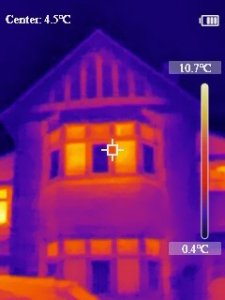
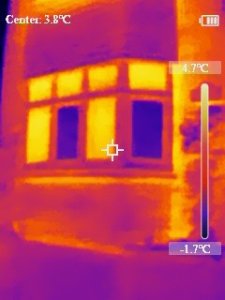
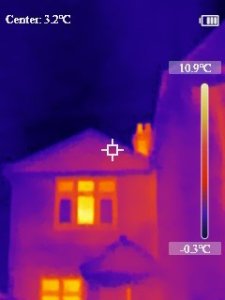
Traditional double glazing reduces heat loss by trapping air or gas between panes. However, that gas still allows some convection and conduction to occur.
This is where vacuum glazing changes the equation.
How the Vacuum Improves Insulation
The key advantage of vacuum insulated glass is that it removes the medium that allows heat to travel through the cavity.
When the space between the panes becomes a vacuum:
- Convection cannot occur because there is no air to circulate.
- Conduction through the cavity is drastically reduced because there are almost no gas molecules present.
With two major heat transfer pathways removed, the window becomes significantly more efficient at preventing heat loss.
This is the fundamental reason vacuum glazing delivers such high levels of insulation.
What Are the Levels of Insulation?
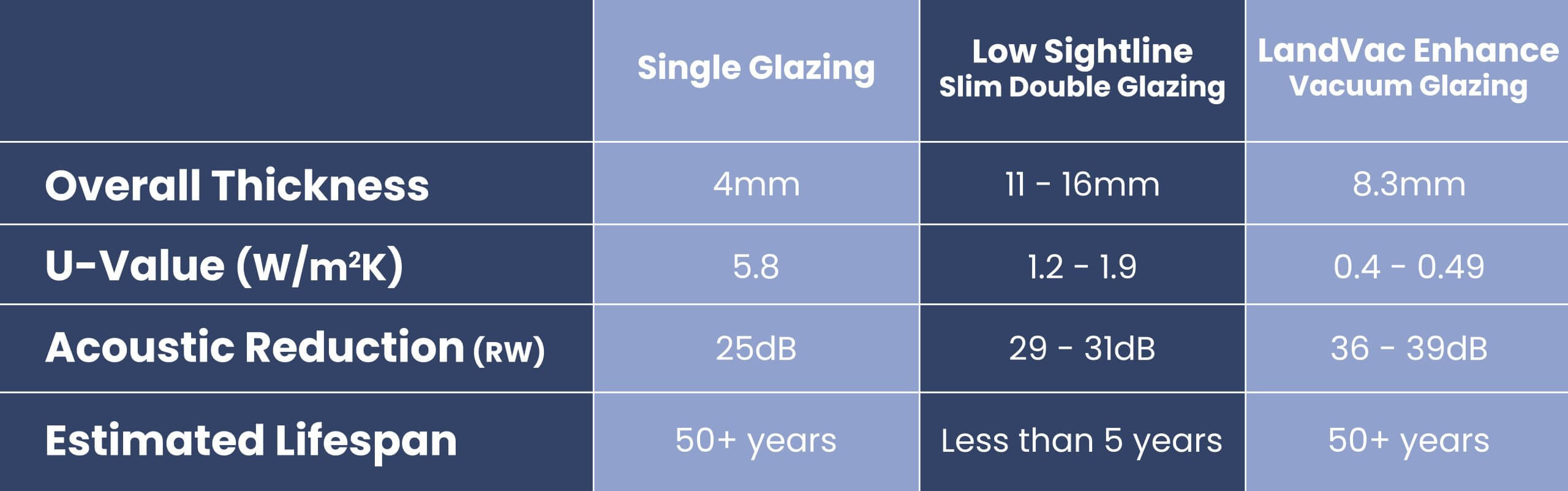
Insulation in glazing is typically measured using a U-value. A U-value indicates how easily heat passes through a material such as a window or wall.
Lower U-values mean better insulation and less heat loss, while higher U-values indicate poorer thermal performance.
How LandVac Compares to Traditional Glazing